


The research activity focuses on the development, integration, and application of sensors and measurement technologies for the built environment, with particular emphasis on indoor comfort and indoor air quality, adopting a data-driven, user-centered, and energy-sustainability-oriented approach. The activities include the design of advanced experimental setups, the metrological validation of measurement systems, and data analysis using statistical and artificial intelligence techniques.
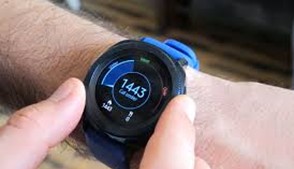
With regard to thermal comfort, innovative measurement setups based on physiological parameters—such as ECG (for Heart Rate Variability extraction), PPG, skin temperature, and data from wearable devices (e.g., smartwatches)—are developed and validated. The integration of physiological signals with environmental variables (temperature, humidity, air velocity, and radiant temperature) enables an indirect, continuous, and personalized assessment of comfort, overcoming the limitations of traditional approaches based solely on environmental indices or questionnaires.
The activities also include the development of advanced thermal comfort models, such as simplified and adaptive versions of PMV, and the application of machine learning and deep learning techniques (e.g., LSTM, CNN, supervised and unsupervised approaches) for the estimation, prediction, and dynamic management of indoor comfort in smart buildings.
A further research area concerns the development of multi-objective comfort optimization methods and algorithms that simultaneously account for environmental conditions, user preferences and behavior, and energy consumption. These algorithms support intelligent and personalized HVAC control strategies, aiming to improve occupants’ well-being while reducing the energy impact of buildings.
Regarding indoor air quality, the research activity includes the development, metrological characterization, calibration, and validation of low-cost sensors and distributed sensor networks for monitoring parameters such as CO₂, particulate matter (PM), and other pollutants. Reliable and replicable measurement procedures are defined both in controlled environments and in real-world scenarios, with particular attention to sensor performance evaluation (accuracy, precision, uncertainty) and data analysis for applications in residential and working environments, also supporting data-driven services for smart buildings.
Within the framework of indoor well-being monitoring, the use of an autonomous service robot is investigated as a mobile measurement platform capable of integrating environmental sensors and data acquisition systems. The robot enables dynamic and spatially distributed measurements within buildings, overcoming the limitations of fixed sensors and allowing a more accurate spatial characterization of parameters related to thermal comfort, indoor air quality, and energy consumption. This approach supports the development of intelligent services for smart buildings by combining environmental data, comfort models, and data-driven analysis for assessing occupants’ well-being and optimizing energy performance.
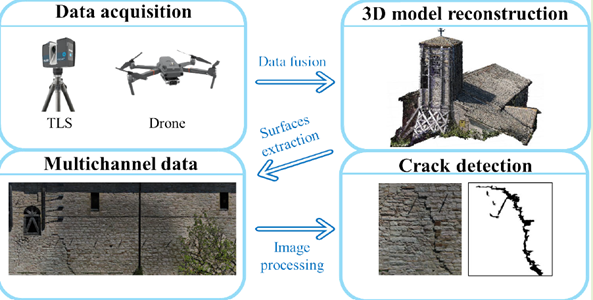
Research activities in the field of Structural Health Monitoring (SHM) focus on the development of multisensor and non-destructive measurement procedures for the identification and assessment of structural damage in buildings, particularly in post-seismic scenarios. In this context, remote sensing technologies (drones equipped with RGB and thermal cameras, terrestrial laser scanners – TLS) are integrated with data fusion techniques to reconstruct high-resolution 3D models of structures. From these models, multimodal data (visual, thermal, and geometric) are extracted and used for the automatic detection of surface damage and discontinuities. The activities also include the development and application of artificial intelligence and deep learning algorithms (e.g., U-Net networks) for crack segmentation and identification, supported by preprocessing techniques (PCA) and morphological postprocessing to reduce false positives and improve result reliability. This approach enables an objective and quantitative assessment of structural health, enhancing operator safety, reducing inspection time compared to traditional methods, and supporting decision-making processes for intervention prioritization and building lifecycle management.
Prof. Gian Marco Revel
Tel. +39 071 220 4518
email: gm.revel@staff.univpm.it
Prof.ssa Sara Casaccia
Tel. +39 071 220 4273
email: s.casaccia@staff.univpm.it
Prof. Nicole Morresi
Tel. +39 071 220 4273
email: n.morresi@staff.univpm.it